Keep Your Saxophone Round Your Neck!
Disclaimer: all products on this page have been supplied to me as free review samples.
What makes a good saxophone strap/sling/holder?
The most important thing on any saxophone strap is the hook. On older slings these are just plain metal hooks, and there are two disadvantages. First, the metal of the hook is usually a very hard metal such as steel, and after a while this will wear through a softer metals such as brass. And in case you hadn’t noticed, most saxophones and their strap rings are made of brass. Second, the saxophone can come unhooked. This may not be a common occurrence if you are sitting down playing the saxophone nice and sedately, but how about if you are doing a little choreography as is so often the case these days, accidents can happen. Ouch!
To solve both these issues, many straps now have strong plastic “doglead” type hooks, which can’t wear out the brass and close completely round the strap hook ring on your precious horn.
The other important assets a good saxophone neckstrap has are that it must be adjustable yet stable, ie stay in the position you adjusted it to without slipping. It must be comfortable and not cause any physical harm – human beings have not exactly evolved the perfect body for hanging a large chunk of metal round their necks.
What is the best saxophone strap?
I must admit that when I decided to write this page, I was going to buy, beg, borrow or steal some straps and review them all. That plan went out of the window once I discovered just a very few straps that seemed to me to be way ahead of the field. Until then I had used a de Jacques (with its very clever hook gizmo), a Neotech (with a stretchy bit round your shoulders and a BG, as well as a BG harness on the bass saxophone, though I never got on with harnesses, much too fiddly for me but I like the way a big weight gets distributed more evenly.
Obviously it’s the surface area of the strap that hangs round your neck which is crucial to making your horn feel lighter, and put less strain on your neck and back. For most people, this is not an issue with altos and usually tenors, but baritones and especially basses can feel very heavy, and after a while, I’m sure damage can be done to your body, either by encouraging bad posture in general, or even by compressing discs in your spine or trapping nerves in your neck. The straps I am going to review here are ones that address this age old issue of possible strain and damage to your neck after years of hanging a heavy weight around it.

1. The Jazzlab Saxholder
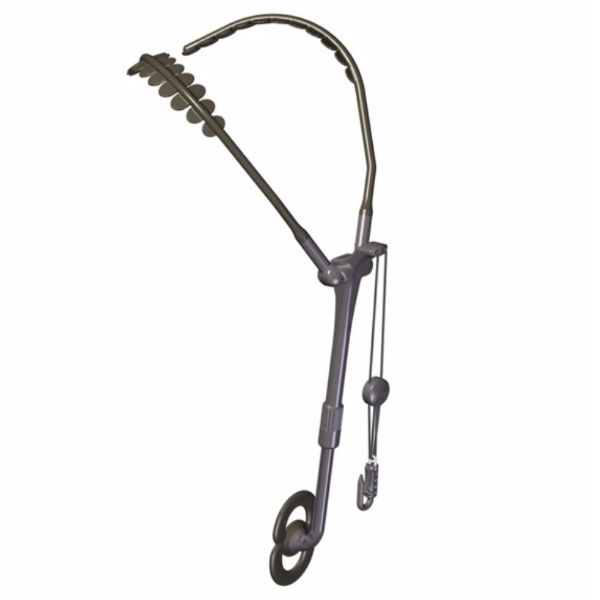
I mentioned above that the important thing to help your poor old neck is the area of the strap in contact with your neck. Well, with the saxholder, nothing comes in contact with your neck. In fact this is not really a strap, it’s more of a, well, sax holder. As you can see there are two “handles” which hang over your shoulders so the weight which would have been on your neck with a conventional strap, is on your shoulders, possibly a much safer situation for your long-term health.
But that’s not all. Only part of the weight is displaced on to your shoulders because there is a pad lower down which rests against your stomach, so much of the weight is also distributed down there. “Is that a good thing?” I hear you ask. I shall answer that in a little while.
I first saw the Saxholder at this year’s Musikmesse trade show in the saxophone hall. I had already met the inventor, Silvin Jancic, when he showed me his mouthpiece silencer the previous year. The Saxholder looked intriguing and as soon as I tried it on I breathed a sigh of relief as I no longer felt the weight on my poor old neck (I have a very heavy bronze and solid silver tenor saxophone to walk around with at those shows). However, the lower pad (the “abdominal rest”) very quickly started to drift to the left as it slid across my stomach. And before you start commenting, it was nothing to do with the size of my stomach, it was just a bit too slippery. I mentioned this to Silvin, who said that he would work on that. Well, I’m happy to say the Saxholder I tried recently has had that issue addressed, and it stays put right there in the middle of your stomach.
What the medical expert says:
Osteopath Chris Galloway was most impressed with the saxholder, saying that it alleviated pressure on the sternocleidomastoid muscle in the neck (which can restrict rotation) and the brachial plexus. He advised widening the shoulder arms so that the pressure was more on the trapezius muscles.
He also cautioned that the abdomen cushion would be better if it was wider and so spread the load (I totally agree with this) and to be careful not to put pressure directly on the diaphragm (just below the ribcage)
So what do I think now that it actually works properly for me? Well, it’s not often I get excited about a saxophone accessory, but I have to say that this is something that totally and utterly astonishes me with its innovative answer to saxophone players’ neck problems. I will probably use this as my main (almost said ” neckstrap” then) saxophone holder.
Do you need different sizes?
No, it’s adjustable. The shoulder handles are made from aluminium and can bent to fit comfortably, the angle between the shoulder handles can be adjusted, and the abdominal rest can be positioned by extending the telescopic slider. You can also adjust the length of the cord to suit your instrument. I found that with the default length it was perfect for alto, tenor and baritone, but I would need it just very slightly shorter for my soprano (if I used a strap on a soprano which I don’t) or for my Buescher bass (which has a very high straphook ring). Having said that, it felt so comfortable on the bass I was inspired to walk around playing the bass, something I hadn’t been previously been inclined to do due to its heaviness.
The Stomach/Abdomen Thing
This is the real innovation. I can imagine people in the past have tried to solve the wight on the neck problem by hanging a saxophone on the shoulders, but that doesn’t work by itself as there is too much weight on the shoulders. The pad resting on your stomach takes a lot of this weight off. Is it a good thing to transfer it somewhere else though? In my opinion the answer is a resounding YES!Not only is the weight transferred to somewhere that has no bones or spinal column to interfere with, I think this can actually help by encouraging proper abdominal/diaphragm breathing as it actually encourages you to keep your stomach firm, even if you are well endowed in that area.
Is It Unisex?
Many ladies complain that traditional saxophone harnesses are especially uncomfortable or unflattering because of the way they hang over or around the breast area. The saxholder has no such issues, so is ideal for ladies.
It seems Too Good to be True! What’s the catch?
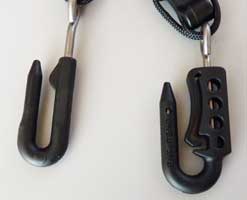 The SaxHolder has recently been updated with a new hook
Well, maybe the fact that the hook is a plain hook instead of a doglead type catch is the only real catch (pun intended). Having said that the hook is a nice strong metal one (steel by the look of it) with a plastic cover that has a small protrusion to make it less likely for the saxophone to jump out, it’s also longer than many hooks which will also help prevent such disasters.
I would also like to see a larger abdomen rest which would spread the weight more, this would be especially useful for baritone and bass. Other than that, my only tiny criticism is that it looks rather utilitarian, perhaps in the future there will be a deluxe version with leather upholstery and walnut trimmings.A new
Finally, I will be very interested to see how this stands up to further testing. My initial thoughts are very positive, but it is the kind of thing that needs assessment over a period of time. I have currently had a few neck problems, and I would be very interested to see what a medical specialist thinks of this (and the Cebulla), I will update this article when I get some feedback on that. This is a very elegant piece of kit which I thoroughly recommend. Even if you don’t have any neck problems, I wouldn’t mind betting that this will go a long way to making sure you don’t get any in the future.
Saxholder Pro
A new recently introduced model is the Saxholder Pro. If you liked the original Saxholder, you’ll probably love this. So what are the main differences between this and the original:
- The covering on the shoulder handles is wider.
- The handles can be locked in place. They lock automatically when in position, and are released by simply pressing a button.
- The handles can be removed. This is done by placing them horizontally, (lining up the arrows) and pulling. They are color coded red and yellow so can be easily attached the right way round even on dimly lit stages.
- The cord length adjuster locks automatically. A realise button allows you to adjust the length.
- The telescopic slider which adjusts the position of the stomach plate locks into place by rotating the locking device (very simple and intuitive)
- The stomach plate itself is does not rotate through 360 degrees sideways as with the original, but still swivels in a vertical plane (forward or backward) to adjust to the contours of your stomach.
- Overall the rounded profile of the vertical telescopic bar is wider and sturdier looking. The look is more elegant and less utilitarian.
The verdict:
This is a big improvement both cosmetically and in regard to functional and ease of use. It is constructed from high grade, maintenance free materials: aircraft aluminium and kevlar (with stainless steel hook). It works just as well sitting down as standing up, moving around or bending down to pick something up. The original cord adjust was the traditional friction based adjuster common to most straps. Although these work as securely as they need to be, you do wonder that at some stage the it friction will eventually wear out the cord. With the lock/release device there is no significant friction on the cord at all, so it feels great and gives you total peace of mind. The cord is regatta cord with a breaking load of 250kg: perfect for a 6kg low A baritone!
In practice, compared with a traditional saxophone strap, it just feels like your saxophone is less than half the weight. As with the original there is no (aucun, keiner, ingen, ninguno, 没有) weight on your neck. I can now play my bass saxophone standing up for hours…
2. The BA Sling

I said above that I don’t like harnesses, although they do of course distribute some weight from your neck onto other areas: your chest, shoulder and back. Apart from feeling rather constricted, I also dislike the palava involved in putting a harness on and taking it off. Another downside to harnesses is that they can be rather uncomfortable for ladies, although some companies do make a female version which is more comfortable around the bosom.
So is the BA Sling a harness or not? It certainly looks like one.
Yes, if you look at the photo the BA sling does look more like a harness, however it’s a clever variant on the standard neckstrap. It holds the horn well with a doglead type metal or plastic clip. The difference is that there is one extra strap which goes round the back of your left shoulder. It’s much easier to put on than a harness, there are no buckles to do up round the back or side.
All you do is place it round your neck as you would with a normal saxophone neckstrap, then pass the second strap around your shoulder. The instructions that come with it are a little confusing, but I contacted the manufacturer and he responded very quickly pointing me towards a video on the website which helped, however in the end I worked it out for myself. Once you know how to put it on, it is very easy.
Does it work?
Yes, it certainly takes a lot of pressure from your neck but I do have a couple of reservations. As it distributes the weight only to one side, I wonder if this is a good thing for your body. Of course, guitarists seem to get used to the weight being on one side and it doesn’t seem to do them any harm, however I intend to also show this one to a medical specialist and get a professional opinion. As with all of these straps, it is best to try them out to see which suits you.
One thought I had about this is that the actual strap around your neck could do with being wider, or having a padded cushion which would help further in distributing the weight that is still on your neck.

3. The Cebulla Strap
The first thing I noticed about this one is the bit missing. It has quite thick and firm padding around the back of your neck, but this is in two sections, allowing a sort of valley so that no pressure is applied to your spine or the center of the back of your neck. The idea behind this is to keep pressure from around the neck vertebrae, and so ensure that there is no stifling of the blood supply to the brain, which could cause fatigue.
There is no mention of this on the site, but I also believe this can help stop problems associated with trapped nerves in your neck, anyone who has suffered mysterious neck pains or tingling in your hands will know what I mean.
OK, what else is good about this. Well, it’s made of leather and has a real quality feel and look to it. The adjusting mechanism appears very simple, but really locks into position and is designed so your fingers fit neatly into the concave sides without slipping. The actual strap is a strong nylon cord, unlike the flat woven straps you get which can be very annoying as the adjustors often don’t lie flat against you, but get twisted round so the edge cuts into you. And the hook is a plastic doglead type hook (carabiner) that won’t allow your horn the freedom to crash to the floor. On the site there are are also metal ones.
Why all the different sizes?
The Cebulla comes in different sizes, but I found that the tenor strap was fine to use on alto, tenor, baritone and bass. On alto, the padding extends round the side of your neck and actually keeps the strap away from the artery.
As well as the tenor, I have the baritone saxophone strap. This is only very slightly longer, the should strap is a bit wider and the padding is not only thicker but seems to be firmer also. Obviously this is necessary to cope with the extra weight in order to keep the pressure from the neck. However it felt slightly less comfortable as the thicker cushioning makes it feel more like two padded pressure points each side of your spine, rather than the more spread out feel of the tenor strap.
Basically because of the thicker and harder material the two pads seem to have a smaller contact area even though the strap is wider. However once I tried this on the bass, that problem disappeared as the extra weight helped the “spread”. The great thing is, I mentioned this to Johann Cebulla who makes the straps, and he mentioned that it can take a while for the sling to settle in, and that everyone is different, but the great thing is he thanked me for the feedback and said that he would take account of the smaller contact area and think about making it wider.
Update: Response from Johann
…we worked on your idea for a bigger contact area regarding to the Bari-Strap. Here is the result: The cushioning is much longer so that you have more contact.
Further Update:

A new version now incorporates a wider adjustment plate, which apparently was part of the original design. This is not as wide as the one on the Bird Strap (see below) but is certainly wide enough to part the nylon cord further, meaning even less possibility of even the slightest pressure on the sides of your neck near the carotid artery. Whether or not (with a normal strap) the cord touches your neck heavily enough to cause any possible negative effects, the mere fact that you don’t feel anything seems to give you a real feeling of freedom of movement which can’t be a bad thing.
What’s more the plate is actually easier to adjust up and down, and absolutely no slippage.
4. The Bird Strap
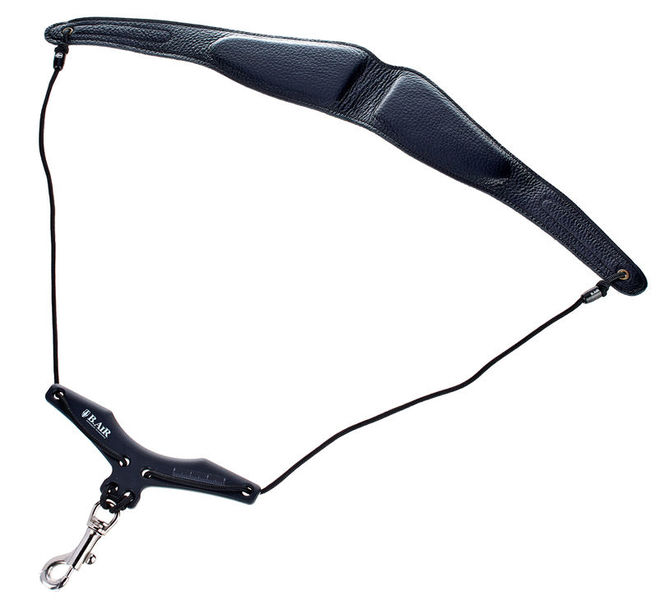
I stumbled upon this very interesting saxophone strap at the Frankfurt Musikmesse this year (2012). The padded leather neckpiece is similar in shape to the Cebulla and has the similar groove in the padding, in order to keep weight from pressing on your spine, which is a good thing.
The padding is not as thick as the Cebulla and appears to be slightly firmer, which some people may prefer although this really is very much a matter of personal preference. I found that this means it takes a while for the strap to bed in and conform to the shape of your neck, which could put off some of the less patient among us. You can get this in different designs and colors to suit most tastes, though it would be nice to also have an option for thicker and softer padding.
Update several weeks later: I have been giving this strap quite a rigourous testing, and have found that the neck padding is still not bedding in as well to the shape of your neck as it might, each side of the center fold seems to want to remain straight rather than forming a curve round your neck.
Where this differs quite radically from the Cebulla is in a couple of intriguing features. The first being the extra wide adjustment plate. (NB: Since originally writing this, the Cebulla now has a wider plate, see the update above). This holds position just as steadily as the Cebulla, but it has the added value of separating the cord more, and so decreasing the possibility of constricting the front and sides of your neck near the carotid artery.
This adjuster is easy to move and does not slip. I have to say that although I have not been aware of discomfort from a neckstrap in this area, once you experience the separated cord, it does seem to make a positive difference to the way it feels. Also, where the cord passes through the adjuster is a ruler, which I presume is to allow you to make marks on the cord if you want to quickly adjust to a predetermined position. A nice touch but I wonder how many people would actually use it.
One other feature is something I have some reservations about. This is the cryogenic hook. Yes, folks, this has been treated to -196 degrees centigrade which “dramatically upgrades the vibration efficiency of the metal instruments and its parts It is a special audio technique invented exclusively by B_AIR”. I have heard people say that a metal hook can actually improve the sound of the instrument, so theoretically if you change the metal in some way by cryogenically treating it, then there could be some effect, however I am unable to notice any difference between using this strap or any other strap whether or not the hook is metal or plastic so maybe if there is any sound improvement it’s too subtle for me to hear the difference.
One thing that struck me as odd though, is that if the cryogenically treated metal hook does improve the sound, then why would they put a piece of plastic around it? Obviously this is to protect the hook from wearing, but surely it would negate any possible beneficial effects of the metal. When I asked about this, I was told that it can be removed. I haven’t done this yet, so until I have fully tested with and without the plastic, my jury is still out on the advantage of a cryogenic hook on your strap. Whatever the outcome, this is still a very good strap.
 5. Boston Sax Shop “Newbury Street”
Latest addition to the strap reviews is the BSS – Boston Sax Shop. This has what is becoming a typical “handlebar moustache” cushioned neck with what I call the “spine slot” or “neck notch.” This means the cushioning at the back has a valley in the middle (as with the the Cebulla) so does not put pressure on any bits of knobbly vertebrae you may have.
The review strap I received was size L, and was fine for my alto, tenor and baritone. Tenor and baritone were adjusted somewhere in the middle. For all three altos (Selmer BA, Buescher 400 TH&C and Cafesaxophone) it was fully adjusted to its shortest length, so would be nice to have a little extra adjustment. At its shortest it was just a tad too long for my Buecher bass (which has a very high strap ring) so the M or ML would probably be best for me (and I imagine, for most people)
All reviewers need to find a fault with something just to, look impartial (which I am) but this one took me a long time to find anything I would like improved and I’ll come back to that at the end.
So let’s start with the good stuff:
This strap has the nicest leather I’ve seen for a long time. It is supple enough to bed in to your neck very quickly and looks great with a very fine grain (or whatever the word is for leather). So it is very comfy, with soft yet firm padding (if you know what I mean) especially with the aforementioned neck notch.
Moving on down, the cord is very strong looking parachute type cord. Obviously the ideal neck strap review would be done after 20 years or so just to check it really will hold up, but this one (like the Cebulla) exudes longevity and with fastening at the top ends that fill me with confidence.
Now for the best bit. I’m a big fan of the neckstrap crossbar that holds the cord apart and this is the best I’ve seen. Nice and wide which is exactly want you want to stop any kind of constriction of the throat. I was impressed by the strong look of the plastic until I picked it up and realised it was metal, so even better: strong looking black painted aluminium.
Finally the hook: this is your standard dog lead type trigger hook and appears to be stainless steel so top marks for that. (EDIT: yes it is, just checked the Boston Sax Shop Website). It has some tubing over the hook to prevent wearing out the strap hook ring of your saxophone. Which brings me on to the only negative thing I could find: what happens when this wears out?
Well I thought it was going to be negative, but I just noticed a piece of black tubing on the floor, which looks exactly the same and I realised that must be a spare that fell out of the packaging. So not so negative after all (but maybe a few more spares would be useful). The one on the hook seemed to be well stuck to it, so I suppose it is heat shrunk, (an instruction manual would probably have confirmed that). Anyway it looks tough enough to last a long time. All in all a very professional well designed and well made strap. Newbury Street! (Why is a neck strap called Newbury Street I wonder? Maybe try next PPT mouthpiece will be the Tooting Broadway model)


