
Rock & Roll (& Blues) for Beginners I
Although you might think that theory and rock or blues playing don’t have much in common, it’s surprising how useful a bit of basic music training can be when learning any style of music, however much that style relies an a “feel”.
I have met loads of great rock and rhythm & blues saxophonists, and all of them had a surprisingly good knowledge of theory and used it along with highly developed ears and a masterful knowledge of the genre (all of which can be learnt you will be pleased to know).
To follow this lesson, I suggest you get hold of a keyboard, it doesn’t matter whether you can play piano – you just need to play a few notes with one hand. You also need a very basic knowledge of music theory (e.g. that there are twelve semitones in an octave and seven notes in a major scale).
The first thing you need to think about is how each note of a major scale can be thought to correspond to a number, and how those numbers are used to define the interval between different notes of the scale. Note that the number “1” is always the root, whatever key. So in C, the root note C is 1. In Bb the root note Bb is 1. You always count up from the root:

As you may know, the total number of notes in an octave is 12, of which only 7 make up the major scale. We call the notes that are in the scale diatonic, and the notes that aren’t we call chromatic(black notes in the key of C).
OK, so let’s look at a simple 3 note chord (triad). This is a C major triad and consists of the Root (1st) 3rd and 5th notes:

- The root to the 3rd is called a major 3rd interval (a 3rd because you count the steps inclusively – 123). This is made up of two whole tones (ie 4 semitones)
- The interval between the root and 5th is a perfect 5th (two tones, a semitone and a tone, or 7 semitones)
- The interval between the 3rd and 5th is a 3rd, (3 – 4 – 5) but is not the same as the major 3rd between C and E. Have a look at the table above and play the notesd on a keyboard – you will see it has only one whole tone and a semitone – (or 3 semitones). We call this a minor 3rd.
We are now going to build a chord based on the 4th note of the C scale. This chord is F major:

Things now look a bit more complicated, however in rock and blues it’s common to just use three note chords, but it’s still worth learning about four note chords..
As well as numbering the notes in relation to the the tonic note of the key (C), we now also need to be able to number the notes relative to the root of the chord (F). To do this we use two numbering systems which can be easily differentiated – arabic and roman numerals. We use roman numerals for the notes relative to the tonic (or key center of the tune), and arabic numerals to count up from the root of whatever chord we are talking about. This may seem complicated at first, but if you look at the next table, you should understand why this actually makes things clearer:

As with the C chord, the interval between the 1st and 3rd of an F chord is also a major 3rd and the interval between the 1st and 5th is a perfect 5th. These two intervals define this also as a major chord. As with the C, we only have three notes so this is also a triad
With a very standard 12 bar blues or rock sequence there are often only three chords. We now know chords I and IV. The final chord to think about is chord V, built on the 5th degree of the C scale. This is the chord of G, and if you look at (and listen to) the intervals between the 1st and 3rd, and the 1st and 5th, you will discover that this is also a major triad:
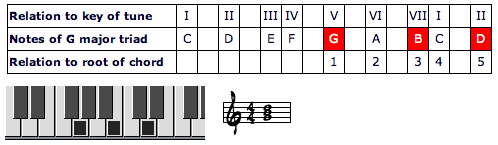
As you can see, these two systems of numbering actually make things easier as we will need to think about chords in two ways:
- The root (1st note) of the chord in relation to the key we are in. (chord IV, chord V etc. of the key of C)
- The notes of the chord relative to the root of the chord (1st, 3rd, 5th etc.).
In these examples I have been talking about the key of C but the same principle applies to any key. Of course, you will need to be able to play in more than one key – all of them sooner or later – so I suggest you get back to the keyboard (and your own instrument) and start learning the I, IV and V triad chords in different keys. As well as counting the intervals and working out the theory, make sure that above all, you listen.
Part 2: 4 Note Chords
Quick Recap:
- Triads are made from the 1st, 3rd and 5th note counting up from the chord’s root.
- (Very often) the root of a chord in a tune is based on a note of the scale of key signature.
- We can either refer to the chord by its root and chord type (e.g. D major, F major) or else by its relation to the tonic using the roman numeral system (e.g.chord I, chord IV in the key of G, F, Bb etc.)
Adding the fourth note:
We usually add the 7th note to the 1st, 3rd and 5th. But it’s not always that easy in rock and blues. The good news is that (unlike jazz) we don’t often need any more than four different notes in a chord
In this illustration we see the I, IV and V chords with added fourth note:

Note that the C and F chords are called major7 chords, but the G is just plain G7. This is because of the actualinterval between the root (1st) and 7th notes.In the C major 7 chord the interval between C and B is 11 semitones (one short of an octave), but with the G7 chord the interval is only 10 semitones (or one whole tone smaller than an octave). We can abbreviate C major 7 to C maj7 or Cma7. The G7 type of chord can be referred to as a dominant 7 chord. If you play these chords on a keyboard you will hear the difference in sound between a major 7 chord and a dominant 7 chord. In most types of conventional western music the dominant 7 (chord V7) is a very important chord as it has a strong tendency to move (or resolve back to the tonic chord (chord I) and marks the end of a musical phrase, often called a cadence.
BUT – It’s A Bit Different in Rock & Blues
On a keyboard, you probably noticed that the major 7 chords have a very particular sound, not very rock & roll or blues. In rock music these chords are usually altered to have bluesier color. We looked at major 7 chords first because this type of construction follows the rules and I believe it’s important to know the rules before you break the rules, or rather adapt them to become something we can use in blues. So we convert the major 7ths to 7ths (blue notes) by flattening them by one semitone.
However when played on the saxophone or sung, the interval might be not an exact semitone – that’s all part of the blues – but for now we’ll call it a semitone.
Here is the same table but with the flattened notes in chords I and IV:

There’s one more thing you need to know about chords I and IV. Sometimes we can use the 6th instead of the 7th:

Part 3: Blue Notes & Blues Scales
Let’s put these chords together in a typical rock & roll 12 bar blues sequence.

You can see here how we think of this as 3 four-bar phrases. Melodic phrases can be made up from various scales to fit this sequence, but in rock & blues, the basic major scale is quite rare. We have already seen how the 7th note of the C major scale (B) is flattened to a Bb when making the four-note chord of C7, but there are a couple more typical “blue notes”. These are the flattened 3rd (b3) and flattened 5th (b5).
Beware:
It does’nt work the other way round. If the chord has a flattened blues note in it, a non flattened note in the melody will sound bd – ie, don’t play a B with a C7 chord (which has a Bb flattened blues note in it).
It’s absolutely fine to use one of these blue notes in a melody along with the unaltered (unflattened) note in a chord. This means you can play an Eb or Gb along with the E and G of a C, C6 or C7 chord. And you also have the choiceof playing the unaltered notes, E and G.
There are two main blues scales that are useful, the minor blues scale and the major blues scale. Many people call the minor blues scale “The Blues Scale”. Possibly because this scale can be easier to use, as it fits over the entire 12 bar sequence, regardless of whether the chord is a I, IV or V. So this scale is very useful for beginners as it is not easy to play a “wrong” note! Howver very soon it can become boring and this is where some of this blues music theory comes in useful. The following table shows the major scale compared with these two blues scales. Look at these very carefully, play them on a keyboard or your saxophone and listen carefully before moving on to the next bit.
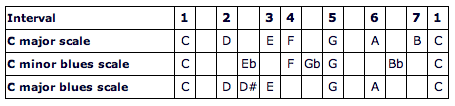
N.B. The Gb could also be written as F#
Both of these scales are derived from simpler “pentatonic” (five note) scales that are common in folk music all over the world. The Gb in the minor blues and the D# are added notes and are often used along with notes either side as passing notes.
Putting the theory into practice
Minor blues scale
I mentioned that the minor blues scale sounds OK over the whole sequence, so let’s look at how it fits against chords I and IV. This table shows chords I and IV in the key of C and how the minor blues scale of C fits against the two chords. I have spread the notes out over more than one octave to help show how they fit the scale.

- C fits against C of both chords
- Eb sounds as a blue note against E of chord, and fits the Eb (7th) of the F7
- F fits against the F of the F7, can sound slightly dissonant against the C chord but works well passing between the other notes
- F# (Gb) can sound slightly dissonant but works well passing between the other notes
- G fits against G of the C7 chord, sounds very slightly dissonant against the F but creates nice tension
- Bb fits against the Bb of C7 chord, slightly dissonant against the F and adds tension
Similarly there are some slight dissonances playing the C minor blues scale against the V chord (G7), but still works well with lots of blues color and feel.
Using this scale for improvising on a 12 bar rock or blues can really help a beginner to gain confidence. You do not need to change the scale as the chords change, however as soon as possible you should avoid just running up and down the scale. Try to play melodic phrases built from notes of the scale and see how the phrases can fit together to make a more melodic solo. Don’t be afraid of leaving spaces, as well as helping with the structure of a solo they also give you a chance to think about what to play next.
Listen very carefully to what you play, although a very general rule is that this scale fits over all the chords, some notes are often best avoided in some places – when playing over the G7 chord it will often be best to avoid the note C until the G7 “resolves” to the C chord. This is a good way of making the melody complement the way that a V7 – I chord change (a cadence) creates and releases tension.
Major blues scale
The thing that makes a blues solo start to get interesting is when you learn how and when to use notes from the major blues scale as well as the minor. This table shows the same two chords (I and IV in C) but with a C major blues scale:

- C fits against C of C7
- D & D# works well passing between the C and E
- E fits against the E of the C7 chord but sounds very bad against the Eb of the F7
- G fits against G of the C7 chord
- A sounds a bit dissonant on the C7, but adds tension
As you can see the major blues scale in C fits nicely against the C7 chord but does not work against the F7. It is not so easy to use as the minor blues scale because this scale does’nt fit over the all of the chords, but can be used over a chord if the root of the scale is the same as the root of the chord, so a C major blues scale fits a C7, an F major blues scale fits an F7. So as you start to learn, it can be useful o use the C minor blues scale anywhere on a C blues, but use the C major blues scale only on the C chords (bars 1-4, 7-8 and 11-12). In other words, you would use the C minor blues scale over bars 5-6 and 9-10

A very important note is the 3rd, and it’s very common to use a phrase with a major 3rd on chord I, then repeat the phrase over chord IV but flatten the major 3rd. This way the 3rd of the C chord (E) becomes the b7 of the F chord (Eb). This is easier to understand if you invert the notes of the IV chord (i.e. put them in a different order).

PART 4: PUTTING IT ALL TOGETHER
You can combine all the things we covered here to create an interesting and rocking solo with a great blues feel. But also try just playing long notes with or without effects such as growling and note bending. Bending notes is very useful when playing flattened blue notes as you can play slightly sharper or flatter than the actual pitch to get a much better blues feel. You can also use the normal major scale if you like, sometimes with a flattened 3rd or 7th. At other times you can just play a phrase that makes sense musically but may not conform to any of these rules. The important thing is to get all these different things balanced – too much of any one technique can become predictable. Above all don’t be scared of repeating phrases or leaving gaps – these are all useful musical tools that also give you time to think about what to play next.
As a practical example: Analyzing a Rock & Roll Solo “Slippin’ and Slidin’“

