
What is altissimo?
The altissimo range of the saxophone consists of many notes higher than the “standard” range that is taught in elementary and intermediate stages of learning (up to F or F# with instruments that have that key).
The fingerings for these notes can be quite complex. They differ from instrument to instrument, the fingering chart here show fingerings which I have found to be most useful on many different saxophones, but you can experiment by adding or taking away fingers to suit yours.
Before you start learning extra-high notes
- You need to be able to play the higher notes of the actual register (C3-F3) strongly and with confidence, using not only palm key fingerings but also aux F fingering for F and E.
- Even if you can play these higher notes of the normal register with confidence, make sure you have developed your low notes. There is no point in learning altissmo if you are still unable to play low notes quietly.
- Practice harmonics (overtones) . learning to play and control overtones is a great way to lay the foundations of a good upper range.
You will often need to change your embouchure to get the high notes. Although some teachers would say it is bad technique to adjust your embouchure in order to voice certain notes, the altissimo range can be an exception, and often just a little more pressure is necessary, but without undue biting.
Do you need harder reeds or a wider tip mouthpiece for altissimo?
A good question, to which the answer might be yes and no. Harder reeds or wider tip opening on your mouthpiece may help get the notes, but very often at the expense of low notes. It stands to reason that you would not want to develop a good top end if it’s at the expense of low notes. In the short-term if using a harder reed means you can get the high notes, it can actually be a good thing because you will get to “hear” the notes in your head, ie how they should sound before you play them. This is sometimes referred to as “voicing”. So it can be useful to use a slightly harder reed while learning to play the altissimo notes, then revert to a softer reed once you feel confident about voicing the notes, and use your diaphragm and breath support to be able to articulate and sustain the notes. This way you will not sacrifice your low notes.
Altissimo Fingering Charts

| ALTO | TENOR | ||
|---|---|---|---|
| F |  |
|
In order to use the altissimo range above this it is important to get familiar with the front F (AKA auxilliary F) key as shown here. Played with the index finger. |
| F# |  |
 |
Of course, if your saxophone has an F# key, then you could use it instead. |
| G | 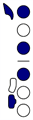 |
 |
This is one of the harder altissimo notes, even though it’s not very high. |
| G# |  |
|
Another difficult note, try this once you are comfortable with some easier ones such as A |
| A |  |
|
The R.H. fingers are optional, they help with intonation. |
| Bb |  |
|
This is the Bb fingering I use, it may not be the easiest to blow, but it’s easy to move to this from the A |
| B |  |
|
Likewise, this allows you to move easily from the Bb |
| C |  |
|
This fingering will also get the high F above |
| C# |  |
|
This is really just an overblown F# |
| D |  |
|
Although it is very high, this should be quite an easy note to blow. Once you get it, try alternating with a bottom Bb |
Extract from Sam Donahue book: High Note Book For Saxophone:


Do you have a chart for bari? I play on a Bundy from the late 70s
Sorry no. It may be best to start trying what alto and/or tenor fingerings work for baritone. Also bear in mind that any chart for more modern baris may not necessarily work on your Bundy.
Ask on Cafesaxophone, I bet someone will have some ideas.
Hi, how to play E followed by F# when one does not have the F# kee ?
Thanks for your advice
I would probably use the front E, which is the same as front (aux) F but with the LH G key added.
OK Thanks, I’ll try that