The PPT Mouthpiece Story
Like many saxophone players I have been on a constant search for the ideal saxophone sound. I was after a mouthpiece that not only gave me something back, but at the same time allowed me to get my own sound (or rather sounds because I need a lot of versatility). For quite a long time I stuck with an Otto Link STM 7* on tenor, but although I was quite happy with the sound for some styles, I found it not quite versatile enough for my work as a session musician, so I started to look around and try different mouthpieces, including Lawton, Guy Hawkins, Wolf Tayne, Berg Larsen, Vandoren and Dave Guardala, all of which had something about them I liked, but none of which did everything I wanted. Was that too much to ask? No, so with the help of master craftsman and Acoustician Ed Pillinger I developed my own range: PPT mouthpieces.
Who plays PPT Mouthpieces?
(Video by Space Rehearsal & Recording)


-

PPT Soprano Mouthpiece
Price range: £210.00 through £240.00 Select options This product has multiple variants. The options may be chosen on the product page -
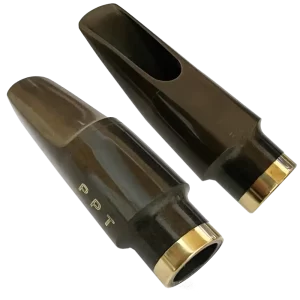
PPT Alto Mouthpiece
Price range: £210.00 through £250.00 Select options This product has multiple variants. The options may be chosen on the product page -

PPT Tenor Mouthpiece
Price range: £230.00 through £260.00 Select options This product has multiple variants. The options may be chosen on the product page -

PPT Baritone Mouthpiece
Price range: £270.00 through £290.00 Select options This product has multiple variants. The options may be chosen on the product page
- Tenor PPT Reviews
I’ve been playing the ebonite 9* PPT tenor mpc for a couple of months now. And I can say this is one fantastic mpc. It is perfect for my purposes, playing mostly blues, old school R&B, and some jazz. This mouthpiece is extremely versatile; pushing it will raise the roof, but the sound does not get thin or shrill like it does with a lot of high baffle mpcs. At the other end of the spectrum, it plays with a beautiful subtone, especially in the low register. And the tone quality is great at any volume. Some mpcs lock you into a certain tone; but the PPT allows me to ‘shape the sound’ to get the tone I’m after.
The PPT is very responsive and plays easily, even with the large tip opening. It will take a ton of air, but also respond to the slightest whisper. When pushed it develops a nice edge, but the tone stays solid. The lowest notes play well and the altissimo pops right out, better than most mpcs I’ve played.
I’ve owned and played a few truly great mpcs, both high and low baffle styles, and this one is as good or better than any of them. The more I play it, the better it gets. Thanks for a great mpc, Pete!
John Lull
Hi Pete,
I liked to write a review.
It’s an incredibly good mouthpiece and day after day it shows more and more of what it can do.
Great Fun and very versatile!yesterday morning I picked up the PPT Onyxite 9 * and in the afternoon I went to the rehearsal room to try it in peace and in all volumes with different reeds.
Honestly I am thrilled and fascinated at the same time. I’ve never played such an incredibly flexible and enjoyable mouthpiece.
You will find my first feedback on your website (and copy down here).
If you like to post it further feel free to do it!Cheers,
Leo
Gerry baker (verified owner) – August 14, 2018
I have been playing the #8* onyxite mouthpiece on my Bauhaus M2 tenor, and found it versatility has expanded the range of the sax out of recognition. Previously dull notes now sparkle, and are more easy to express. It will Roar or whisper at will. Blues shifts can make you cry (in a good way). Swing just takes you to a different era. Jazz really feels like you are sitting behind the stand with the band’s logo. I can’t wait to pick it up to see what it will give today. Vandoren ZZ Jazz seem to give best range but unfiled Java half a point harder also give excellent response. There is however one serious drawback . I have to put it down to eat and sleep, just to keep the family happy, so be warned these mouthpieces are addictive, LOL. How lucky we are to have people like you Pete, researching and refining mouthpiece design to give us more than was even thought of before, and profits to charity. It’s a no brainer everybody should have one. Thanks again Pete
Hi Pete, Just to let you know thanks for letting me try out your mouthpiece. I have it as essential part of my saxophone set up. It really works for me is capable of doing anything ….any style. I used this on Roger Daltreys last album. One track with Pete Townsend , there was inter play with sax and Guitar. You’re flippin terrific Pete Thomases mouthpiece was gripping to the tarmac like crazy. From down the bottom of the horn to harmonics I never even realised I could manage. Unfortunately I didn’t have his mouthpiece on my baritone. That was a Berg Larsen. Happy blowing where ever you are.
Big Mart Winning.
(Van Morrison Band. John Martyn . Nick Lowe. Lee Scratch Perry. Dennis Brown Ray Charles . Tanita Tikaram. Hillbilly Moon Explosion. Chris Farlowe . Roger Daltrey)
“First impressions. I love the way the mouthpiece looks, and it is beautifully finished for a prototype. Fortunately had an old 2 screw Lig that fit. Spent about half an hour going back and forth between my 10MFan Boss and the Hooligan. Tried a 2 1/2 Bass Clarinet and 3 and 3 1/2 Tenor Sax Legere Signature Reeds.
Facing curve works well on all 3 no quackiness or other oddities. As expected the 3 is easier at this stage to go quietly down low but was a little more fussy on altissimo. A few hours of get to know are in order.
Sound wise my first impressions are its not quite as raspy as my Boss can be but offers a wider palette in the more civilized range of sax noises. I use a 10MFan Robusto for section work which is a great section mouthpiece.
Mid point of the soundscape of the PPT is between the two others. Time will tell, but I think the altissimo on Pete’s piece is capable of being a little fuller if not overblown. Both Boss and PPT can shriek up there if pushed.
Again first impressions but I think the PPT Hooligan has the widest sound palette of any mpce I have played so far. Intonation on my SML Gold Medal 1 requires a wee bit less correction on the PPT than the Boss which indicates to me that the mpce and SML are a great match. Big bore horn and big open mpce.
Nicely free blowing which Suits my style. A few hours of long tones at the bottom and altissimo ends will tell the tale.
Oops forgot to add, it’s nicely balanced across the range of the horn.”
– Jazzaferri (PPT Tenor Hooligan prototype)
Hi Pete
This is just a feedback. Just received this morning a tenor onyxite #9. At first when I placed my reed on the mouthpiece and saw the gap at the tip, I said to myself, “I’ll never be able to get a decent sound out of my sax !” Then my first reaction was : If possible, I’ll exchange it for a #8.Just finished playing with the #9 for 1 hour 1/2. At first, as planned, nothing decent came out. But after fiddling around with different reeds and ligatures, the sound just blew out ! Then the next level I experienced was not being able to control the sound to my liking ! But hey… I ‘m getting there. The sound is still not as I want it to be but it’s looking good and I think it holds lots of possibilities. So I’ll keep my #9.
And a big thumbs up for all the work you’ve been doing for many years. I’ve been coming to your site for severals years now.
All the best
Pierre

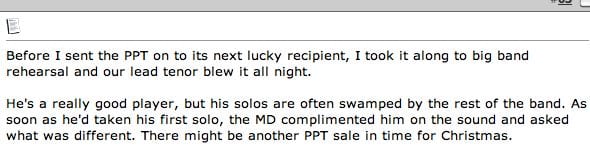
By email:


From the Cafesaxophone Forum:
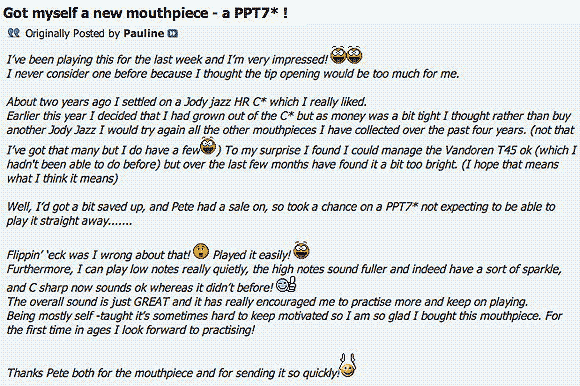
Very thanks for mouthpiece… It’s Great !!
Hi Pete,
I received the mouthpiece yesterday and just love it. My teacher also said that he thought the tone on my SX90R was very good with the PPT. The piece is very easy to play and I cannot put my sax down, Thanks again. Best Regards, Hermann
Just got the mouthpiece plays incredibly! thank you so much. Not only for a great cause but I now get this wonderful rich smokey jazz tone on my tenor, Just incredibly responsive to my embouchure and I can’t stop raving about it. – Mark Lesser
Mr. Thomas,
Just wanted to let you know that I finally got the mouthpiece in the mail today. i was getting a little worried seeing that im in Afghanistan right now and it had to go all the way back to the states then over here. It took me a couple tries to find the right set up, but once i did i instantly fell in love with it. I cant wait to play on it for my next dixieland jazz gig over here.
Thanks again, Matt
Pete,
After a few scales to warm it up, I played a couple favorite pieces and liked the sound. Smooth when you want it that way and will bark when you ask it to.
Brian Kidwell
Hello Pete,
Just to let you know: I collected the two mpc’s from the postoffice and finished testplaying them. They are fabolous! My grilfriend liked the new onyxite even better than the one I was borrowing from Ruud de Vries, but we both are absolutely enthousiastich about the bronzite! It seems to give me just that litlle extra ‘bite’ I was hoping for! Yesterday I did a gig with a 1930’s swingorchestra (in which I play the lower tenor parts and a couple of solo’s). I used the borrowed onyxite and I got the impression, judiging by the reactions of the band and the audience, that I came close to my idea of a “bigger than life” sound. We played acoustically and I had no trouble at all in either blending in the section or ‘competing’ with the full orchestra – and this all with a nice ‘vintage’ sound. Thanks a lot for your beautiful work!I intend to use the bronzite also in a more modern project. It may very well be that thanks to your mpc’s I finally found the sound I was looking for.
Best wishes, Kurt Schwab
Hallo Pete,
this is Klaus from Bonn. I just playtested the PPT Bronzite 7* for about one hour. Here is my first impression.I am enthusiasticated about the MPC. It is very freeblowing from the first minute and the sound is very much variabel. I played it soft in a Ballad and hard and loud in a Rock’n Roll tune. The PPT works perfect form low to high. You can produce a soft tone or even an edgy sound. And it is not necessary to use too much power. I tried it with two types of reeds. First with my standard reed Vandoren V 16 , 3.0. Here the MPC works superb. Then I tried the Vandoren new red Java 3.0 which I use also on my JJ Hard Rubber 7*. This reed is not the best one for the PPT. I also tried my standard Vandoren Optimum Ligature. It fits perfectly and works excellent with the PPT. So far my first comment. I will play the PPT on a gig in the next days and will give you a report again afterwards. All over I can say in the moment : The PPT Bronzite 7 * topped my expectations.
I hope, I found the right words. It is not so easy for me to do it in english. Thank you.
Klaus
Dear Pete,
I have received your mouthpiece, thank you! It really shows craftmanship. I am an Otto Link player for 20 years, therefore I have to get used to the PPT and blow it for a longer period to see if it’s for me or not. The mouthpiece is much smaller in the mouth so I get tired in the muscles soon. So: to early to really say something about it right now. I let you know later how it worked out!
Thanks again,
With kind regards, Ruud de Vries
Hi Pete,
the ppt mpc. arrived today. Initially I wasnt convinced, I thought the bottom end was nice but the top was shrill, but after half an hour or so I began to warm to it and now I love it.Its as warm and as fat as my berg but the top has more projection and the overall sound has more focus. It works and fits great with an alto francois louis lig. Will give it a good blast at a couple of gigs over the weekend. Aside from the sound, it looks fantastic!!!
regards, Declan Whitston
Pete, The mouthpiece arrived in the mail today and all I can say is -WOW- I didn’t think it would be THIS GOOD! I’d hoped but I’ve tried many a mouthpiece that were pretty good but they lacked something. This mouthpiece has it all! As soon as I started to play it it started singing from top to bottom and man, what a bottom! It is so easy to play and every note is clear and full. I had trouble putting it down in order to write this. Finally I have the sound coming out of the horn I’ve wanted to produce for years. Oh happy day! Thank-you and Ed so much for producing one awesome mouthpiece! Alan Theberge (A Train on SOTW)
Hi Pete – Thanks for the mouthpiece I love it. I was playing a 130/2 Berg so I ordered the 9* PPT. When it arrived I tried it out and thought “Oh no – this is not for me”. I then tried different reeds on it and moved down from a 3.5 plasticover to a medium Fibracell and it made all the difference. I have now been playing it solidly and driving the neighbours mad and it does exactly what you said it would do. I can get the low notes easily and (although not fluent yet) get as far up as high altissimo ‘D’. I am also using your altissimo fingerings which are now starting to pay off.
Many thanks for posting out the PPT Tenor 9* mouthpiece…my first session on it was superb..its the nearest sound on an ebonite piece that duplicates a metal piece but without the screech and wildness…I will update you once I have played it on a gig… Kindest regards David Cole
OK, no rush
I own a PPT 8 already and it’s my main piece now.
It’s so good that I am trying to sell my more expensive pieces like a Parvati and some LAWs and others.
Great job
Keep swinging
Klaus
Hi Pete,
first of all I wish you a happy 2010. Today I got my new Tenor PPT Onyxite 8 * and I don’t hesitate to say : It is fantastic !!!! The sound which I produce on my Selmer Ref 54 is even better as with the PPT 7* Bronzite. I am going to play it with Vandoren V16 or Hemke reeds 2,5 and Vandoren Optimum or Rovner EVO and I will continue to play the PPT 7 * Bronzite with reeds of strength 3,0.As you know, my schoolenglish is not sufficient to describe the sound, but that would be difficult anyway. But for you it is surely essential to know, that I am very happy with the PPTs. Please give my compliments to Ed Pillinger. He is really a great MPC producer.
Klaus from Bonn
Pete,
I received the mouthpiece last week.
It took a little while to get used to the sweetspot as it seems to require a lot less mpc in the mouth than my metal link. But once I found the correct mouth placement and reed (Vandoren Traditional 2) it’s a huge improvement. It was definately worth the wait just to see the look on my teacher’s face at my lesson on Wednesday – he was very impressed and a little jealous. The only thing that I need to work on with it is not overblowing as I’m used to really having to force air through the link. Thanks a lot – money well spent.
regards, Kristian
Hi Pete, The mpc arrived today and I couldn’t resist trying it straight away… This beauty plays on a shoestring, litteraly since I couldn’t find a lig that fit in my drawer. First notes and it sings like my Tone Edge or screams like my STM. Many many thanks to Ed and you 😉 Tomorrow I’ll try and find a suitable lig to really push it, but I already know this one is a keeper and stated so on our French saxofan forum.
StephenD
Hi Pete,
I played the Bari at the big band today. Everyone noticed the amazing quality, intonation and edge that I played today. No fooling. You have a winner. I will tell my friend Mike Brignola about it. He might be interested. Now he is using a Lawton 7BB
Regards, Wally
Hi Pete,
I received the mouthpiece yesterday and just love it. My teacher also said that he thought the tone on my SX90R was very good with the PPT. The piece is very easy to play and I cannot put my sax down, Thanks again.
Best Regards, Hermann
Hi Pete,
Thank you for the PPT 9* tenor mouthpiece (which I received early July) ! I have been playing this mouthpiece for nearly two weeks, and I have to say, this mouthpiece is amazing – even better than the 8* you supplied; very easy to play, great tone and free-blowing. Absolutely brilliant !
Thanks one again !
All the best, Eric
Pete,
Mouthpiece arrived today. I unpacked and gave it a test as quickly as possible. I haven’t the time for extensive testing yet, but the initial test was excellent. I used a Brancher lig that also arrived today (ordered it just for this mouthpiece) and a previously played 2 1/2 Java reed. After a few scales to warm it up, I played a couple favorite pieces and liked the sound. Smooth when you want it that way and will bark when you ask it to.
I will send a sound sample later when I have some time.
Brian
Just got the mouthpiece plays incredibly! thank you so much. Not only for a great cause but I now get this wonderful rich smokey jazz tone on my tenor, Just incredibly responsive to my embouchure and I can’t stop raving about it.
Hi Pete
This morning the PPT it’s arrived. It is very exact and versatile. It is very more differentiated than the O. Link 9*.
Thank you very much!
Hansueli Marti
Hi Pete
I received the mouthpiece yesterday, many thanks for the excellent service. Thought I’d provide a bit of initial feedback.I usually use an Otto Link Tone Edge 7 with Rico Jazz Select reeds strength 2M. My tone on this is fine and blows fairly easily. I also have an Otto Link TE 7* and this blows a bit easier and louder although I find soft playing not quite as controlled.
Before ordering I tried this dark coloured PPT I mentioned elsewhere, and it was the sound of it that made me decide to purchase one.
The one you sent me sounds the same so that’s great 🙂
In comparison I find the Otto Link very stuffy and dull compared to the PPT, when I play the PPT it’s like someone turned the volume up. Instead of now having to really blow to make it sing I can be gentle and it comes out the same volume. Not only that but when I do push the sound really comes out. The sound from the PPT is very pure and clear. The PPT is not at all stuffy, beautifully free blowing. I notice a similarity in the sound produced by the PPT vs Otto Link in that it’s still warm and smokey albeit a bit brighter, but nothing like some other mouthpieces I’ve tried where they are really edgy.
Today I had a lesson with my tutor, James Rawlinson, and played the Otto Link 7* and then the PPT. He was amazed again how clear the PPT is and told me to definitely stick with it, and over time I’ll learn all the differences between the Otto Link and PPT and adjust my playing accordingly. In fact in the lesson he got out the PPT had been lent and played on it the whole lesson too.
So from what I can see so far the description of what the mouthpiece can do matches what I can see, and that’s great! Soft and smokey when you want it to be, and powerful and direct at other times. Amazing projection.
I have also tried a RJ Select 2H and it plays fine too, I’ll have to experiment a bit more the strength of reed I should be using.
Anyway many thanks, love the mouthpiece 🙂
Andy
I got my ppt yesterday. Thank you so much. It plays beautifully
-Jacobus
From: Simon Geschwindt
Message:
Hi Pete, I bought one of your mpcs quite some time ago – an 8. I nearly gave up on it. I’d been playing on a Dukoff D8, and the tip opening of your mpc seemed too daunting. However, I decided to keep at it, and many months later it’s gone into overdrive. High and low notes are much easier than with the D8, and the range of tone is so much wider – from rich subtone to a very rocky edge. I use a YTS-62 with Vandoren Java 3s. Joburg winters are extremely dry, and 3s last a lot longer than softer reeds. I’m writing to you because if any customers get dispirited about how long it takes for the embouchure to adjust, tell them to persevere, even if it takes half a year or more. This is an amazing MPC, and the effort is well worth it. Best wishes
Hi Pete, sure you can quote me. If you want to clean it up a bit, or cut it, feel free. I’d be delighted. I’m absolutely thrilled with the way the MPC has developed. I play mainly outside gigs (see www.simongeschwindt.com), but for lessons inside, the richness and variation of tone colour is an inspiration for students. (They all want one!) And despite the wide tip opening, a hard reed works well if you want a clean sound, especially for solos on tenor of works originally done on soprano, for example,Branford Marsalis on Sting’s Little Wing.
All the best, Simon[collapse]
What’s different about PPTs?
Historically mouthpiece makers aimed for consistency across the range, so their alto is like a smaller version of their tenor. But there is a big flaw here. Back in the golden age of jazz and R&B saxophone, tenor players found that Otto Link or Berg Larsen suited the tenor, alto players found that Meyer or Brilhart suited the alto. So for this very reason PPT tenors, altos, sopranos and baritones each have a different design to bring out the best whatever size saxophone you play. However I found that there was nothing that fitted nicely between a Link and. Larsen, so this was my goal – my quest for the holy grail of mouthpiece. The PPT tenor has a big chamber, and a baffle that took months to perfect. It can give a sparkle or edge to a sound that Otto link players have to really struggle to get but at the same time it is actually capable of real warm lushness that can be elusive with a Berg Larsen. We refined the concept of the Larsen baffle by using much smoother contours. And in the end it paid off. PPTs are molded from scratch using various composites chosen for strength, acoustic properties and of course, safety.
Materials
- Black HD Resin A high density hard rubber (ebonite) and bronze composite – very attractive pearlescent look
- Onyxite (custom orders only) – White stone powder resin composite.
Originally PPTs were available in dark blue or bronzite (a resin compound that includes bronze powder). MKII PPTs were made with a new composite, Onyxite, that included powdered stone. These are still available as a custom order. MKIII PPTs are Black HD Pearlescent (Resin), a brand new formula that includes bronze powder and hard rubber (ebonite). The density is designed to be the same as grenadilla wood which has the same sound but very slightly more conistent across the dynamic range. However when we talk about the sound of a mouthpiece material, it is often a very subtle difference – The basic sound of all resin PPTs is so similar that it is not realistic to differentiate via sound clips. Low baffle pieces (such as the alto and soprano) can have very slight differences between onyxite and HD resin, however the higher baffle mouthpieces such as the tenor do not. If we are able to accurately record any differences then sound clips will be posted.
Recommended ligatures:
- Marc Jean (contact manufacturer for exact PPT models)
- Baritone: (Rovner Bass Clarinet Dark 3RL or Light L10)
- Baritone: GF bass clarinet 05M BGG 13
- Tenor HD Resin: (Rovner Star HR tenor SS-2R)
- Alto 5 & 6: Any HR alto ligature (e.g. Rovner Star SS-1RL )
- Alto 8* Hooligan: Any Bb clarinet ligature
The inspiration behind the different models
Tenor
Think of a wilder Otto Link or an easier to control Berg Larsen. While developing it I was currently expoerimenting with vandorens and RPC to get that elusive sound and response I knew must exist somewhere so those pieces are also inspirations for the PPT tenor
Alto
This was a bit easier. We got hold of about 20 vintage Meyers, each was quite different and simply chose the best one and made a very close copy.
Soprano
This was based on a vintage Selmer Soloist, but with a lot of work done to the throat. Dimensions were tricky, because it was necessary to find just the right throat and chamber combination to sweeten the sound but without the intonation suffering.
Baritone
This was easy. I just happened to own the very best slant signature Link baritone mouthpiece. So we copied that. The Power is the same but with a similar baffle to the PPT tenor – a smoother semi-subtle bullet shape.
About the New “Hooligan” Models
We are finally very proud to offer a new line in PPT mouthpieces for those with no fear (of the neighbours) – the Power & Hooligan models. This has taken years in research and development. Originally made with purple resin, these are now also available in black HD pearlescent (resin).
Hooligan by Name, Hooligan by Nature
Wild, bright, dirty gritty and totally irresponsible. But of course in the right hands it can be tamed. But maybe tamed is the wrong word – this is unlikely ever to sound tame, however you should be able to bend it to your will without losing any hooliganality. On to the sound concept. I was not just after a bright, edgy “paint peeler” – there are plenty of those around. One of the things saxophone players seek in a blues or rock mouthpiece is an elusive kind of sound that I call “grit,” and a truly gritty sound is what we are aiming for with this mouthpiece. Of course the player him or herself can supply that, but it really does help if the mouthpiece is amenable. Otherwise attempts to add grit can often just sound overblown and have a tendency to sound flat.
Inspiration for the Hooligan Alto
We started out working on the alto version. Originally we thought of taking a typical “holy grail” New York Meyer Brothers type mouthpiece and adding a baffle. Sounds easy, but that didn’t quite work in the way we wanted. One reason this has taken so long in development is that getting the perfection you strive for is not an exact science. A lot of trial and error is involved getting not just the right baffle and chamber combination, but the best facing curve. All these factors contribute to what makes it work the way we want. We only produce the alto with a wide 8* facing, as that is the facing that works best in combination with the chamber and baffle, however custom orders are of course possible for different facings.
So what is the Power?
The Power is a sort of slightly less bright design and we use if for the baritone where often want not quite so much edge. You can still get the edge, but it’s just more of a baritony sort of edge.Plenty of grunt and fatness. It is maybe slightly better behaved than the Hooligan, but still capable of some bad behaviour. Of course you can get a really hooligan baritone if you want (at your own risk) via a custom order.
“First impressions. I love the way the mouthpiece looks, and it is beautifully finished for a prototype. Fortunately had an old 2 screw Lig that fit. Spent about half an hour going back and forth between my 10MFan Boss and the Hooligan. Tried a 2 1/2 Bass Clarinet and 3 and 3 1/2 Tenor Sax Legere Signature Reeds. Facing curve works well on all 3 no quackiness or other oddities. As expected the 3 is easier at this stage to go quietly down low but was a little more fussy on altissimo. A few hours of get to know are in order. Sound wise my first impressions are its not quite as raspy as my Boss can be but offers a wider palette in the more civilized range of sax noises. I use a 10MFan Robusto for section work which is a great section mouthpiece. Mid point of the soundscape of the PPT is between the two others. Time will tell, but I think the altissimo on Pete’s piece is capable of being a little fuller if not overblown. Both Boss and PPT can shriek up there if pushed. Again first impressions but I think the PPT Hooligan has the widest sound palette of any mpce I have played so far. Intonation on my SML Gold Medal 1 requires a wee bit less correction on the PPT than the Boss which indicates to me that the mpce and SML are a great match. Big bore horn and big open mpce. Nicely free blowing which Suits my style. A few hours of long tones at the bottom and altissimo ends will tell the tale. Oops forgot to add, it’s nicely balanced across the range of the horn.” Jazzaferri (PPT Tenor Hooligan prototype)
Inspiration for the Hooligan Tenor
This one goes to 11. The tenor is closer to the standard PPT in that the baffle is very similar, and in spite of the huge tip (11) is surprisingly easy to blow. For intense rock and roll, this allows you to really push the sound into overdrive, with a huge growl that doesn’t force the flatness you often get when pushing so much air into the instrument.
Audio
Alto
Cafe Blues Strictly Mambo A Minor Blues Hooligan Blues (Hooligan) The Other Side of the Lounge (Hooligan) Alto 6** Noodling in A Alto 6** Noodling in Dm
Soundfile by David Roach
Tenor
Another Night – Tenor Resin Harlem Nocturne – Tenor Resin Evening Blues – Tenor Metal TCL – Tenor Metal
Baritone
Blackjack Jump – Baritone Power Walk the talk – Baritone Signature Big Girls Blues – Baritone Signature Lowdown Blues – Baritone Signature
Soprano
Love Them Soprano Blues Noodling on Soprano Soprano 1 Soprano 2
-
PPT Soprano Mouthpiece
Price range: £210.00 through £240.00 Select options This product has multiple variants. The options may be chosen on the product page -
PPT Alto Mouthpiece
Price range: £210.00 through £250.00 Select options This product has multiple variants. The options may be chosen on the product page -
PPT Tenor Mouthpiece
Price range: £230.00 through £260.00 Select options This product has multiple variants. The options may be chosen on the product page -
PPT Baritone Mouthpiece
Price range: £270.00 through £290.00 Select options This product has multiple variants. The options may be chosen on the product page


