Choosing your Mouthpiece
It sometimes takes me about 2 weeks to really know if a mouthpiece is right or not and so it is not always a good idea to make that decision in a shop. However most decent retailers should let you try out various saxophone mouthpieces at home, as long as you use a mouthpiece patch. This is usually a sale on approval with the option to return rather than a loan. This can be refunded within a certain time provided the mouthpiece is not worn or damaged.
However a useful strategy can be to try out a large number of mouthpieces in a shop. Spend a whole afternoon or more and narrow the choice down to a few and ask for a home trial on just those ones. Make sure you have several different reed makes and/or strengths to try them with.
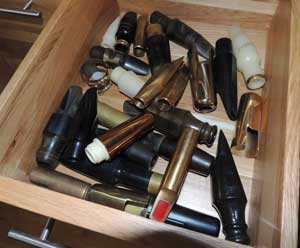
After the player, the mouthpiece is the most important part of shaping the saxophone sound. More so than the saxophone itself – getting a new mouthpiece will have a much larger impact on your sound than getting a new saxophone. Most saxophone players I know have a drawer full of mouthpieces.
Recommendations and Advice
For beginners, I recommend a Yamaha or Hite Premier mouthpiece. Yamahas are quite cheap and usually far superior to the mouthpieces that come with student model saxophones.
After a while many sax players want to get something a bit more special, and this is where the new PPT fits in. I have developed this as the answer for anyone looking for the ultimate in versatile mouthpieces. These are hand-made and finished by world-renowned mouthpiece experts, Edward Pillinger and Morgan Fry. I like these mouthpieces as they have a tremendous dynamic range.
The baffle (see below) allows you to play very loud and bright, but unlike most mouthpieces with fairly high baffles, you can also play quietly and with a warm dark tone. They are the most versatile mouthpieces I have found. They allow the player to develop his/her own sound rather than imposing
the sound which many modern mouthpieces can do.
On alto I currently use a PPT, but can also highly recommend RPC custom, Jody Jazz HR and the Rousseaux JDX7. I have recently done the alto mouthpiece comparison sound test and have discovered some more very interesting mouthpieces,
However the important thing about mouthpieces though is that very often recommendations can be misleading. What suits one person doesn’t suit another. If you are looking to emulate the sound of your favourite player, it doesn’t always make sense to expect the same mouthpiece to give you that sound. Other mouthpieces which I’ve tried and got on with are RPC, Drake, Brancher and Francois Louis. To find out what is best for you, the best thing to do is try them out.
Naming the Parts


Table
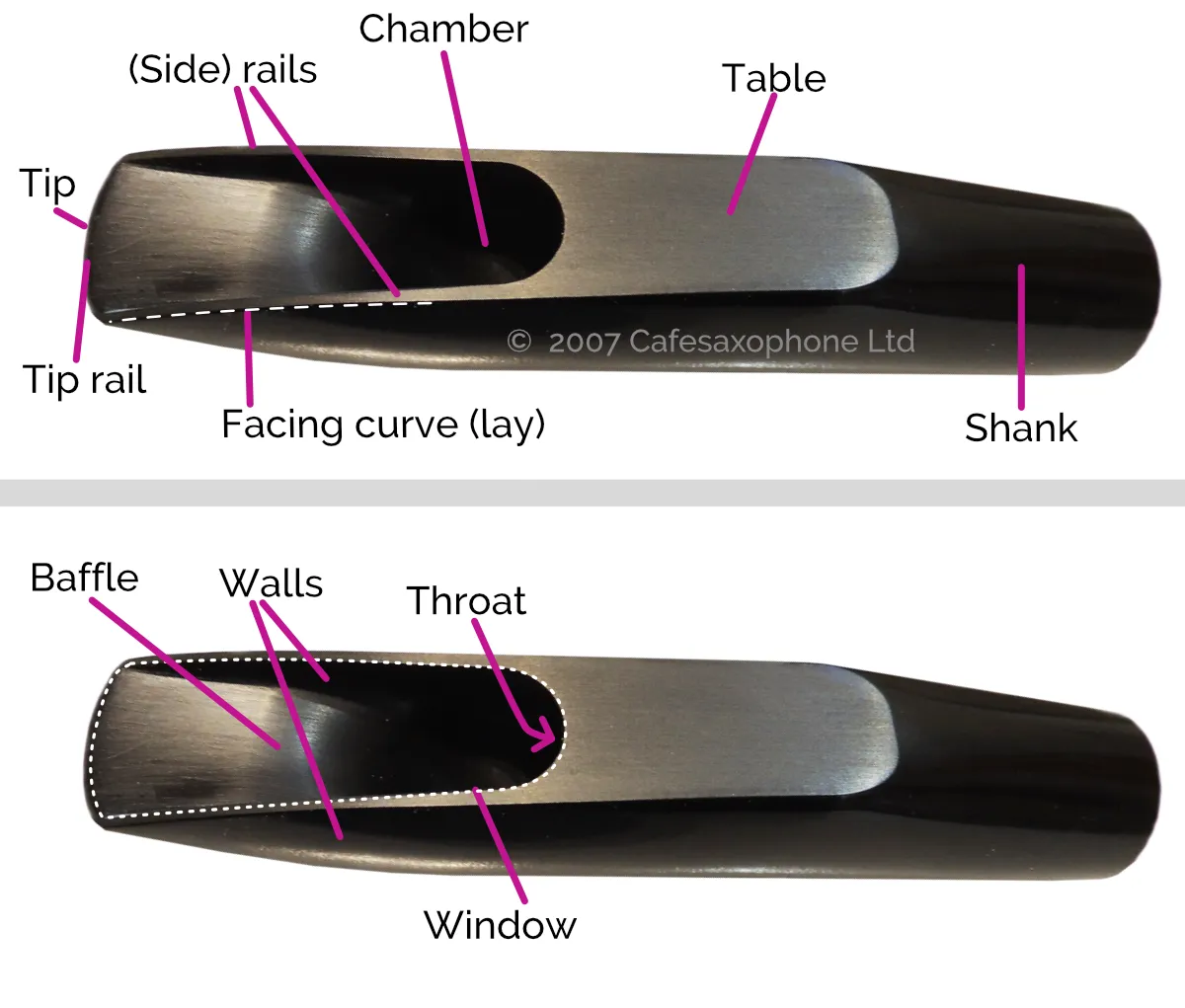
This is the part of the mouthpiece that the reed is clamped onto by the ligature. I prefer it if the table is totally flat, though some manufacturers make the table very slightly concave from front to back (or possibly from side to side). As a reed gets wet, it can often swell slightly. A concave table can accommodate to a certain extent, however this type of table can be very susceptible to ligature issues. For this reason, I believe if a reed does swell, it is best to cure it by flattening the reed, so that it will lie flat against a flat mouthpiece table.
If mouthpiece table is flat:
Provided the reed is not distorted, any good fitting ligature will work. There should be no significant difference in sound between one ligature and another. If the reed swells due to moisture, you should adjust the reed with a blade or reed tool.
If mouthpiece table is concave:
Some mouthpiece tables are concave by design. One theory is that because of the resulting slight gap between reed and table the reed will swell into the concavity and close the gap, however it’s probably best to just make sure you flatten the reed in this case. If the curve of the concavity is from front to back, the tightness and position of the ligature can be critical.
If the concavity is from side to side, the way the ligature applies pressure can be critical. If it applies pressure to the center of the reed, it will push the reed down into the concavity and so create a good seal. But if it applies pressure at the edges, then it could cause the gap to remain. This means the reed does not seal well and can cause squeaks or deadening of the sound. Both of these situations explain why many people think that a ligature affects the sound.
Note that if the reed swells into the concavity then it is unlikely to perform well on a different mouthpiece. For this, and other reasons, I believe a flat table is preferable to a concave table.
Chamber
The cavity inside the main body of the mouthpiece. The size and shape of the chamber can have an important effect on the sound. More modern mouthpieces often have a smaller chamber which can achieve a brighter tone.
Tip
The very tip of the mouthpiece. This should line up with the tip of the reed when looking at the reed side of the mouthpiece. The distance between the tip of the mouthpiece and the tip of the reed is the measurement by which most mouthpiece makers differentiate different mouthpiece “sizes”, see the tenor saxophone mouthpiece facing chart below. However this is really only one part of various elements that determine how a mouthpiece responds.
Rails
The sides of the mouthpiece along the vibrating part of the reed. The thickness of the rails has an effect on the sound. They should be symmetrical.
Lay (AKA Facing Curve)
The curved part of the mouthpiece. This curve (ie the curve of the rails) allows the reed to vibrate. The length of the lay or facing curve can be measured from the point at which the curve starts to the tip.
NB: the word “Facing” is often used to describe a combination of the tip size and the facing curve (or length). If a mouthpiece technician (aka “refacer”) works on your mouthpiece they may talk about changing the facing, as a common way to alter the tip size is to adjust the facing curve. This can be done with or ithout altering the actual length of the curve.
Shank
The part that joins onto the neck of the saxophone. There must be an airtight seal between the inside of the shank and the neck cork.
Baffle
A relatively modern innovation. Some mouthpieces have a wedge shape built up inside which causes the airstream to flow faster, resulting in a brighter, more cutting sound. Baffles vary in size and shape.
Ligature
I have now started a whole page just for ligatures
Dimensions
It’s often said that the wider the tip opening, the softer the reeds required. Although this can be true when you are comparing different size mouthpieces of the same make and model, it is not always a rule that you can apply generally. There are many other factors to take into account when it comes to how easy blowing or how resistant a mouthpiece seems to the player. Baffle shape & size, chamber shape & size and the length & shape of the facing curve all play a role.
The chamber and baffle have a great effect on the tone, but the length of lay and width of tip opening are usually the most important considerations for the player when choosing mouthpieces for your saxophone. Wider tip openings can be harder to play, though it is the combination of lay length and tip opening that really determines this.
A long lay can make a wide tip opening easier. A short lay can make a narrower tip opening harder to play.
I like to use a fairly wide tip and medium soft reeds on tenor (Rico Jazz Select, Vandoren or Alexander). On alto soprano and baritones I use relatively closer tip openings, but still with fairly soft reeds.
Material: does it make a difference to the sound?
This is quite a controversial subject, I’ve now dedicated a whole page to the effect of saxophone mouthpiece material on the sound


