
Best Practice!
As a teacher I used to devise a different practice schedule for each student as different people have different requirements when practicing the saxophone, so the following is quite general and may not suit everyone. However there is one key element for a successful and efficient practice routine, that is concentration. To learn the saxophone it is important to be able to focus the mind – a short session in which you are focussing on, listening to and thinking about what your breath, tongue and fingers are doing is much better than one long session in which your mind is wandering – you will end up learning more in the shorter more focussed session..
How Long to Practise?
If you are at all serious about learning the saxophone, a minimum daily requirement would be 30 minutes practice, but ideally at least an hour. If you intend to become professional then at least 2-3 hours daily is appropriate. It should be possible to practice all day, but remember that once you are no longer concentrating, the practice session becomes much less worthwhile.
General Hints & Tips
- Don’t get obsessive about one thing, if something is very difficult it can be better to take a few days break then come back to it. I have often found that when you do, there is a mysterious improvement even though you have not practiced that thing.
- If you find your mind is not able to concentrate on practicing, then find something else to do. This could be unrelated like doing some sport, reading or just living. If you want to find something saxophone related then try learning some music theory or transcribing a solo
- Thirty minutes daily practice is better than 7 hours a week all in one day
- If you feel inhibited due to neighbours complaining try to find somewhere else where you feel totally at ease and able to play as loud as you like
- If you have trouble with concentration, try some simple courses in yoga or meditation
- If you are unable to practice the saxophone, e.g. when travelling, you can still practice breathing exercises (and tongue articulation – try repeating
t-t-t-t-t
as evenly as possible, gradually work up the tempo). - Frequent short sessions in which your mind is concentrating is better than one longer session in which you cannot concentrate. If you are able and happy to spend many hours per day practicing, take frequent breaks to help keep your mind fresh.
Organising Your Practicing Routine
Divide your practice session into three main areas. Alternate between these so as to minimise boredom or lack of concentration:
- Tone – long notes, breathing exercises etc
- Technical facility – fingering exercises, scales, arpeggios
- Music – Playing (and learning) tunes and licks, having fun playing along with CDs etc.
My preference is to practice in this order. Tone exercises are the hardest to concentrate on for many people, it is easy to let your mind wander while playing long notes. You get the most benefit if you can really focus on the sound and get inside it
. I find this easier at the start of the practice session (ideally early in the day also) when your mind is freshest and able to concentrate.
In any session longer than one hour I recommend that you rotate the above three areas, so start on tone again after an hour.
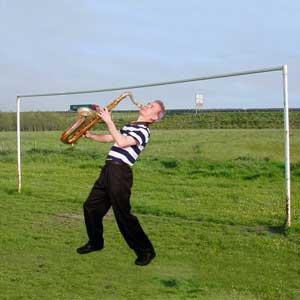
Setting The Goalposts
The important thing is to set various goals – aim for something you can achieve and always keep this in mind. It may just mean learning one scale, or it could be learning a certain pattern in all keys, or it could be working something up to a specific tempo.You can have various smaller goals, but also one big one, e.g. by the end of this week I will learn a harmonic minor scale in the keys of Am, Dm, Gm, Cm and Fm, but by the end of the year I will play all major and minor scales in all keys. You will find it’s incredibly useful to be able to measure your steps forward, using a metronome is invaluable. Once you have learnt a scale for instance, that’s not the end of it. You need to play it:
- In time with the metronome
- Gradually be able to play at faster tempos (always staying in time)
- Playing it with different articulations (tongued, legato, staccato etc – and always staying in time)
Important: The goal must be just right. Too easy and you achieve nothing, too hard and you will get frustrated, lose concentration and possibly get depressed about the whole idea of learning the saxophone. If you are not able to work out these goals (and at first it can be difficult to evaluate possible improvement), then this is something you must do with the aid of a good teacher – who (ideally) would already be doing something like this.
Practice Guidelines By Dr. Laurie Stras – Performance Coordinator, University of Southampton. Efficient practice is essential to effective learning, but most people haven’t a clue how to practice, going about it without direction or purpose. Practice itself is a skill that requires concentration and discipline; it is neither instinctive nor innate, but something that must be developed. Everyone could benefit from more time to practice, but by using your time effectively, you can learn to achieve in one hour what you might not have achieved in three before.
Use these guidelines to make your practice focused. You may not agree with all of them initially, but give them a try, and see if you don’t find your working methods improving. Identify the problem. If you make a mistake when practicing, you need to know why it’s happening.
- Is it technical – does it have to do with illogical fingering, wrong hand position, poor posture, poor communication?
- Is it interpretative – do you understand the musical language of the piece?
- Is it memory – have you formed a mental image of the music? Look at your hands and your body (mirrors are always a good idea).
- Can you see any reason why you might be having difficulty?
- Think about the journey the music represents. Are you proceeding from phrase to phrase, from movement to movement in a way that makes sense?
- Think about the melodic and harmonic structure of the piece. Could you – indeed, have you done an analysis?
Tackle one problem at a time. Once you identify what is going wrong, you can rectify it, but your time is best used in concentrated effort. Practise short sections, one phrase, one bar, one beat if necessary; practice up to speed, and don’t play more than you need to. If you decide there is a problem at bar 24, work on it alone. When you have solved it, put it into context with bars 23 and 25. When that goes smoothly, extend around it even further until you are comfortable with the whole passage. Do not think you are going to solve the problem by starting at bar 18, playing until it falls apart at bar 37, and then doing the same thing over and over immediately. You will achieve little or nothing, you will waste valuable practice time, and you risk becoming demoralized.
Discipline yourself. Once you have decided how much you are going to practice, don’t play beyond the limits you have set. You will forget what you set out to achieve. Even if you have decided to play only very short sections, one bar or one beat, stop between each repetition – think about the problem, and think about the success of your solution. If it works, and you know why, you can go onto something else.
Practise to speed. Slow practice is only necessary and valuable until your fingering/tonguing/bowing/breathing is marked in and secure. Thereafter practice at the tempo you intend for performance, otherwise you risk learning the piece using the wrong physical processes to play/sing the notes. You can reinstate slow practice during memorization; playing very slowly and very quietly can help cement the notes in the memory. Listen to your playing/singing. You may think you are making a nice sound, that you are demonstrating well, but try and separate what you are giving out from what you are getting back.
Listening critically can also help you identify particularly intransigent or indeterminate problems. Make notes. You should always bring a pencil to practice and rehearsal, and use it to remind yourself of problems and solutions. If you record your thought processes immediately, you need not spend time thinking through the same issues twice. This applies to fingering, technique, interpretation, ensemble indications – in fact, any sort of decision you might make.
Trust your decisions. Once you have decided on fingering/tonguing/ bowing/breathing, stick to it faithfully. If it doesn’t work, you can always change it, but change the markings in the music, too. If you have two alternatives, write them in and practice them both until you can decide. Know what your eyes are doing. If you need to look at the music, do. If you need to look at your hands/accompanist/ensemble, do. If you have an audience and you want to look up at them, do. But do not allow your eyes to wander; if you do, your mind is wandering as well.
Practise with your eyes closed or in the dark. There is little better test of memory and accuracy. Practising with your eyes closed heightens the other senses, allowing you to concentrate on listening to the sound and feeling your body’s actions.
Work on your technique. Don’t forego technical practice and scales just because you don’t have the time; it is a false economy. Exercises and scales teach you the geography of your instrument/voice; they can strengthen your technique without taxing your musical thought. If you practice them with the same discipline you devote to your pieces, they will help you negotiate the most difficult of passages in the remotest of keys. Keep a practice diary. It is all too easy to forget questions that you might have for your teacher between lessons, especially if you see him/her only fortnightly. If you go on to be a performer or a teacher, you may be called upon at short notice to resurrect something you haven’t played/sung for years. If you have notes from when you first learnt it, and from the last time you performed it, it will be all the easier and quicker to prepare.


