 Taming The Saxophone vol 3
Patterns, scales & licks for intermediate to advanced players. Examples in this section
A great book, I use it every day to keep the chops in order - - Bobby Wellins
A very useful scale!
When applied to a dominant 7, the diminished scale includes several nice extensions and chromatic notes: the b9, b10, #11 and 13 and can be used with a plain dominant 7 or one with those extensions. As you may know the diminished scale can have any root note, there are only three sets of fingerings to learn. (See Scales for Improvisation in the Jazz section).
Each diminished scale is based on one of the four notes of a diminished chord and the interval structure is Tone-Semitone-Tone-Semitone-Tone-Semitone-Tone-Semitone. We can call this the TS (Tone-semitone) or WH (Whole-half) diminished scale.
As a rule of thumb many people think of the scale as “starting on” the b9 of the chord, but of course it could just as easily be the 3rd, 5th or 7th. Perhaps the b9 is easier to mentally commute as it is juts up one semitone.
Ideally you should think of the correct enharmonic spellings, which would vary depending on each dominant 7 chord, however while learning the basic scales and diminished patterns it’s easier to use whatever seems simplest. Here I have mostly followed the convention of sharps ascending and flats descending, but have used B instead of Cb.
As a general rule of thumb, you can think of the
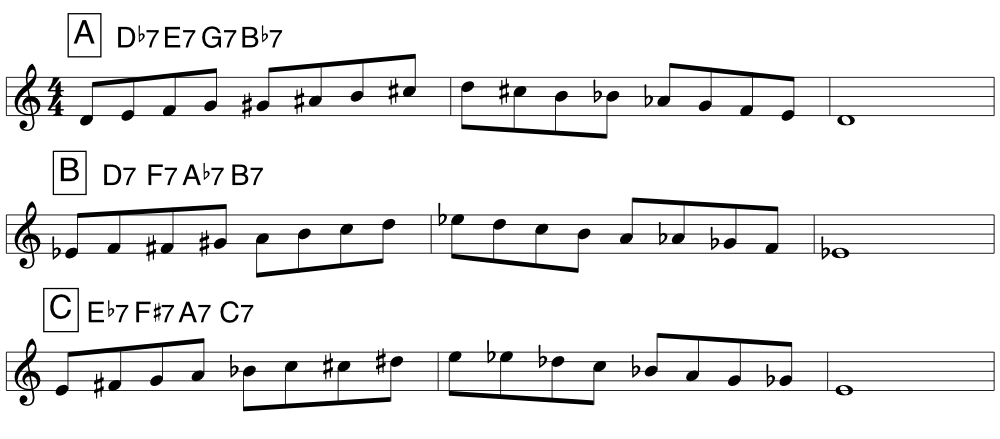
In ex 7.1 we have a basic diminished scales, and as an example of how they work look at the first one (ex 7.1A – starting on D)
If this applies to a Db7 or C#7 the notes are (in ascending order):
b9, #9, 3rd, b5, 5 13, 7
Ex 7.1
Basic Diminished Scales:
Ex 7.2
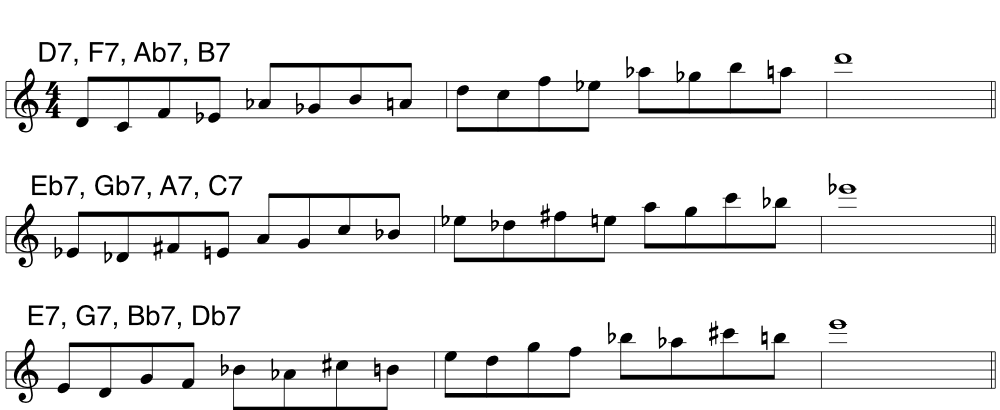
This is one of many useful diminished patterns for improvising, used a lot by Oliver Nelson.
- If used on D7, the opening bar of this example consists of root, 7th, b10th, b9th, b5th, 3rd, 13th, 5th. Of course the Gb in this case would be F#.
- If used on F7, the opening bar of this example consists of 13th, 5th, root, 7th, b10th, b9th, b5th (#11th), 3rd. In this case the 3rd is enharmonically correct.
- If used on Ab7, the opening bar of this example consists of b5th, 3rd, 13th, 5th, root, 7th, #9th, b9th. The A natural in this case would be Bbb.
- If used on B7, the opening bar of this example consists of b10th, b9th, b5th, 3rd, 13th, 5th, root, 7th. In this case the Eb would be D#, Ab would be G# and Gb would be F#.
7.2 (A)
The next example (B) is just an embellishment of (A), which can be played as straight semiquavers as written, or played as a bounced turn as shown here:

7.2 (B)

Ex 7.3
Another very useful diminished scale lick that was used by Coltrane quite a lot. You don’t have to play it exactly as written here, take some time to breathe if you need to!

Ex 7.4

As with Exercise 7-2 this can be also be played as a bounced turn:


