Alternate or Alternative?
The fingerings we are looking at here, and shown in the chart below, are alternative fingerings, either for ease of fingering or preferred sound. These are different to “false” or alternate fingering which actually alternate from one to the other and back again and are used to create a special effect. See here for the alternate or false finding effect
When to use alternative fingerings
- When it would be too difficult to use a regular fingering, use the alternative. This often applies to trills but also to different scales and interval jumps. We show some examples below of musical passages, but once you know the alternatives then you can just have a go at each one and decide which to use by rial and error.
- In some cases there are very slight differences in sound and/or intonation so you may just decide to use a certain fingering for its sound, e.g. the side C is sometimes called the “ballad C” as some people consider it to have a better tone than the regular (front) C.
A chart of common alternatives and when to use them
In the fingering chart below the top F and top E need to be used with the octave key, all the other fingerings apply to both upper and lower register of the saxophone.
NOTE |
REGULAR |
ALT. | |
|---|---|---|---|
| Top F |  |
 |
Auxiliary F (AKA “Front” F) fingering useful for arpeggio F. Also the basis for many altissimo fingerings. This fingering is better than the F palm keys for making a fast interval between C and top F (or any of the left hand fingerings). If you don’t have that key you can fake it |
| Top E |  |
 |
Auxiliary E (AKA “Front” E) fingering, useful for arpeggio F maj7: F A C E F C A F |
| C (Both octaves) |  |
 |
Side C – You may find that this may have a clearer tone and better intonation, so is often used in slow tunes. AKA the “ballad C.” |
| Bb (Both octaves) |  |
 |
Alternative 1: Bb bis. Useful for most cases that do not involve fast transitions from Bb to B or C. Very good for things like interval jumps from Bb to Db or G. |

|
Alternative 2: Fork or forked Bb (aka 1 and 4). Good when jumping to F, or for Bb arpeggio: Bb – D – F.
LH1 and RH2 (aka 1 and 5) is similar and useful for jumps from Gb to Bb. |
||
| G#/Ab (Both octaves) |  |
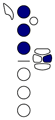 |
Tabbed G# (C#/G# link). This allows you to use the same fingering for low C# as for G#, which can help a lot with scale passages and interval jumps in many sharp keys. |
| Gb/F# (Both octaves) |  |
 |
Side Gb/F# – Useful for trilling F to Gb. On most instruments these days (at east since the 1920s) the articulated G# allows you to finger the G# while playing F#, which makes F# – G# passages more fluent. |

Top F
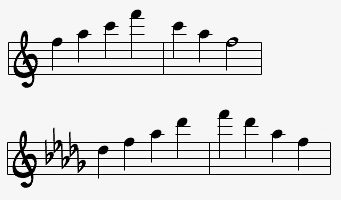 The alternative top F is probably more common than the regular fingering. For example try a basic F arpeggio in the upper register: it’s much easier to use the alternative than the palm keys. Again in the Db arpeggio the alternate fingering works very well. Try both of these with palm keys and notice the difference.
So lets look at when we might use the palm F. Unless you are using it purely for the better sound, only two scenarios come to mind.
1. A chromatic run up and/or down to top D.

The palm keys make the most sense here as the transition from D# to alternative E is quite clumsy.
2. From or to Eb. In the next example we would use the palm key F when going from Eb to F, however in bar 3 where we have a C to F, it makes sense to switch to the alternative F.

If you are reading music, this is a scenario where it’s very important to be looking and thinking ahead, otherwise it’s easy to be caught out.
Best Sound
You will probably find that the palm key fingering sounds better, so for long notes you should probably use this, but do experiment and make up your own mind.
Top (Front) E
This really only works well between E and C or E and F so it works well on an F maj 7 arpeggio:

When the only notes involved are E and F, then either the front keys or palm keys can be used, the decision to use one or the other should be based on what nots come before or after.
You could use either the palm or front F for an E to F trill, but a tremolo between C and E is better with the front E:
Otherwise, for most other high E fingerings you would use the palm key, so in this example, it is awkward to use the front E after the A:
Best Sound
Again, the palm key fingering usually sounds better.
C
The regular C fingering is fine for most cases, but the side key fingering is very good when fast passages, e.g. trills, between B and C are required.
Best Sound
Many people think the side key fingering has the best sound and so use this when there are sustained long notes. I think it may just sound better to the player die to the fact that the side key tone hole is nearer the player’s ears than the front tone hole.
Bb
The mother of alternative fingerings – there are so many choices.
The regular (side key) fingering can be awkward for many intervals due to the fact that you need to apply or release two fingers of opposite hands at once. In most cases the bis fingering is a lot easier. For this reason it’s best to look at when the bis does not work so well i.e. when to use the side key Bb or the fork Bb.
 When not to use the bis key #1
The bis key is mostly a disadvantage when going from Bb to C, so this is good time to use the side key, for example in the key of Bb the opening trill from Bb to C is best using the side key. However the descent back from the D is good on the bis, provided there is not a C immediately after – again when reading music it’s important to think ahead.
Note that it may be possible to trill from Bb to C by using the bis and the C side key, but on may instruments this is not as well in tune as using the side key Bb and trill to standard C.
When not to use the bis key #2
When you have passages involving A# to B:

You can use either the first or second finger of your right hand as shown in the chart. The final note of this example could be a fork or bis, you will notice that if you play the fork fingering and then apply the bis key, it is already held down automatically anyway.
Example Combining Bb Fingerings
Here you would use a combination of bis, side (S) and right hand second finger (RH2)

In the above example (from Taming The Saxophone Vol III – Exercises & Patterns) you could use the regular (sidekey) fingering all the way through, but you can see here a good example of how three different Bb fingerings can be used in the same passage to facilitate the fingering.
This is also a good example of when to use the RH2 fork fingering. You could use RH1, but as your 2nd RH finger is already in place for the F#, this makes total sense.
Best Sound
Most people consider the regular or Bis to be better than the fork fingering
F#/Gb
The alternative F# is usually referred to as the F# trill key, and that is its primary use. Just try trilling from F to F# with the regular F# and you’ll get the point.
It is also useful in various scale passages, especially in the key of F# and C# (Gb), e.g. in C# or F# play from C#, up to F# and down again.
In this example, start with the regular F# and use the side F# at the top of the scale:

However as this scale is continuing on the to the G#, the alternative F# is awkward and in this case it’s best to use the regular fingering:

Tabbed G#/C#
This is a very very useful fingering and applies to any sharp keys with 3 or more sharps (A and onwards). The connecting mechanism means you can hold the G# key down while playing any other note (except G of course). For example while playing an A major scale you can keep your finger in the G#, which obviously makes your fingering life easier.
It is important to understand this mechanism as it is one of the main sources of saxophone leaks, and is very easy to adjust.
There also a link mechanism on modern saxophones that allows you to use the C# key for G#
Try this passage with the regular G# and switch to C# at the lower end of the scale:

Now try it but hold down the C# key for the entire passage and see how much easier it is than switching from G# to C#.
You may find that doing this a lot is rather a strain on your left hand pinky, especially with some older instruments, so it’s important to make sure your saxophone is well regulated and oiled.

