Chords with five or more notes
As we saw in Chord Sequences, four note chords are created by continuing the process of adding notes in intervals of a third to triads. If we extend this process we create 9ths, 11ths and 13ths

Dominant 7ths have a greater scope for extensions and alterations than major 7ths or minor 7ths. With the latter the resulting dissonance is often a disadvantage.
In practice there are various conventions when adding extensions to different chord types:
Major 7 (and 6) chords
- 9ths can be added (but not usually with root in melody)
- 11ths are rare, a sus 4 is much more likely.
- #11th is possible (but not with 5th in melody).
- 13ths unlikely unless dissonance is required.
Remember: 6ths are used as an alternative to major 7ths, either for the distinctive color of the 6th or to harmonise a melody note which is the root or 6th of the chord, in which case a major 7th in the chord may sound wrong.

ex 4b: Major 9 chords
Minor 7 and half diminished chords
9ths and 11ths can be used.
A minor 7 chord with a 9th (nearly always a major 9th) is called a minor 9 chord.

ex 4c: Minor 9 chord
A minor 7th chord with a minor (or flattened) 9th would be called a minor 7 b9. In practice this chord is rarely used.
13ths are not recommended with minor 7th chords as the resulting tritone with the 3rd weakens the impact of the tritone in the (usually) following V7 chord. It also destroys the suspension effect of the resolution of the 7th of the IIm7 to the 3rd of the V7 (ex 4d).

ex 4d-1: The 7th of the IIm7 would usually resolve to the 3rd of the V7. If the Dm7 already had a B in the chord this resolution would be anticipated and therefore weakened (ex 4d-2).
Dominant 7th chords
These frequently extend up to 13ths, with many chromatic alterations of extensions possible and desirable
Upper extensions in jazz are derived from suspensions in classical harmony:
- a 9th derives from a suspension onto a root.
- an 11th derives from a suspension onto a 3rd
- a 13th derives from a suspension onto a 5th
Therefore unless you need dissonant sounding harmony or clusters, bear in mind the following when voicing chords with extensions:
- 9ths are rarely used next to a root.
- 11ths usually omit the 3rd but they can work well next to the 3rd in an inside harmony part (ex 4e)
- 13ths often omit the 5th, but can sometimes include them to create big chords (but with the extension usually in a higher octave, unlike 11ths with 3rds).

ex 4e: 11th chords
An 11th chord sometimes omits the 5th, must have a 7th and may include a 9th.
A 13th chord often omits the 5th, must have a 7th, may include a 9th to support the 13th but would not have an 11th unless stated. If it contains a 9th it is unnecessary to state this in the symbol unless it has been chromatically altered.
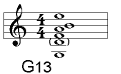
ex 4f: 13th chord
A 13th chord without a 7th would function as a tonic not a dominant chord and therefore most likely be regarded as a 6th or 6/9.
An 11th without a 7th would probably be regarded as a sus4.
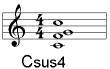
ex 4g: Sus 4 chord
Typical chromatic alterations:

ex 4h: Note that the #9 and b10 have the same notes. The C7 augmented and C7 b13 have the same notes.
- Usually a b10 functions as a suspension of a b9 or 9.
- Usually a #9 would resolve upwards by a semitone.
- Usually a b13 resolves down by a semitone
- Usually an augmented 5th resolves upwards by a semitone
N.B. Extensions are often written as slash chords, e.g. the (preceding) IIm7 chord but with the root of the V7 in the bass (ex 4i).

ex 4i: Slash chords. Note the difference between the slash between the chord and root note and the smaller diagonal sometimes used to separate two extensions as above with 11/13.


